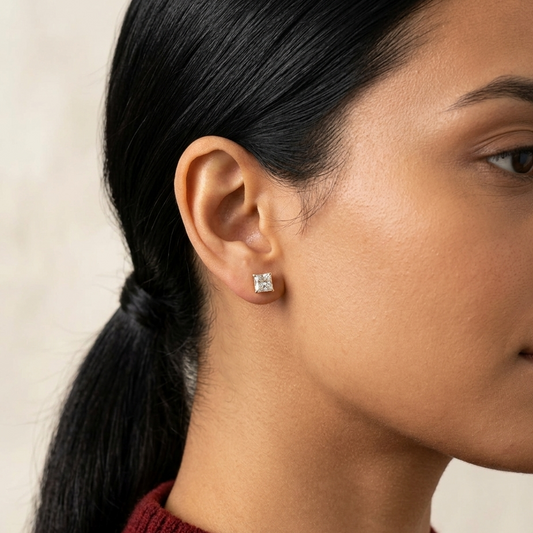
What Is a Lab Grown Diamond? The Complete Guide for Buyers
Share

| A lab grown diamond is a real diamond. It's not a fake. It's not a simulation. It has the same chemical makeup, the same physical hardness, and the same optical brilliance as a diamond that came out of the ground. The only difference is where it was made. |
That distinction matters a lot when you're spending anywhere from $500 to $5,000 or more on a piece of jewelry. And a lot of buyers right now are asking the exact same question you are: is a lab grown diamond actually worth buying, or is there a catch somewhere that nobody's talking about?
This guide is going to answer that honestly. No hype, no sales pitch. Just the facts you need to make a smart purchase decision, including what lab grown diamonds actually are, how they're made, how they compare to mined diamonds, what they cost, and what to watch out for when you shop.
The Actual Science, Explained Simply
A natural diamond forms deep in the earth under extreme heat and pressure over billions of years. A lab grown diamond replicates that exact process, just in a controlled environment and over a matter of weeks rather than eons.
Scientists use two main methods to grow diamonds in a laboratory setting. The first is called High Pressure High Temperature, or HPHT. This method places a small diamond seed inside a machine that subjects it to temperatures above 2,700 degrees Fahrenheit and pressure that mimics conditions about 100 miles below the earth's surface. Carbon atoms arrange themselves around the seed and slowly build into a full diamond crystal.
The second method is Chemical Vapor Deposition, commonly referred to as CVD. In this process, a diamond seed is placed inside a chamber filled with carbon-rich gases. Microwaves or lasers ionize those gases, causing carbon atoms to break free and deposit onto the seed layer by layer, growing the diamond from the top down. CVD tends to produce very pure, high-clarity diamonds and has become the more widely used method in recent years.
Both processes result in a crystal that is, at the atomic level, identical to a mined diamond. Carbon atoms arranged in the same tetrahedral lattice structure. Same hardness of 10 on the Mohs scale. Same refractive index. Same thermal conductivity. Even trained gemologists cannot tell the difference with the naked eye. It takes specialized equipment to distinguish a lab grown diamond from a mined one.
QUICK FACTThe Federal Trade Commission updated its definition of "diamond" in 2018 to include lab grown diamonds. The FTC concluded that the word "natural" is the only accurate distinction between the two. A lab grown diamond is legally and scientifically a diamond, full stop. |
Lab Grown vs. Mined: What Actually Changes?
People get confused here because there's a lot of marketing noise on both sides of this debate. Let's lay it out cleanly.
Feature |
Lab Grown Diamond |
Mined Diamond |
| Chemical composition | Identical (pure carbon) | Identical (pure carbon) |
| Hardness (Mohs scale) | 10 | 10 |
| Brilliance and sparkle | Same | Same |
| Can a gemologist tell apart visually? | No | No |
| GIA or IGI certified? | Yes | Yes |
| Price per carat | 40% to 80% lower | Full market price |
| Long-term resale value | Currently lower | Holds better historically |
| Environmental footprint | Significantly smaller | Large-scale mining required |
| Traceability | Fully traceable origin | Varies by supplier |
The two areas where mined diamonds genuinely hold an advantage right now are resale value and the sentimental weight that comes from a stone formed over billions of years. That second one is personal and not something anyone can really argue you out of. If the geological origin means something to you, that's a legitimate reason to choose a mined stone.
But if you're making a practical decision about getting the most beautiful, highest-quality diamond possible for your money, the math is hard to argue with.
A lab grown diamond doesn't look like a compromise. It looks like a diamond. Because it is one. |
The Price Difference Is Significant, and Here's Why
A one-carat mined diamond of good quality typically retails somewhere between $3,500 and $7,000 in the US market depending on cut, clarity, and color grades. A comparable lab grown diamond in the same carat weight and quality grades will often run between $700 and $1,500. That's a real, meaningful difference.
MINED DIAMOND (1CT, VS2, F)$4,500+Typical retail range in the US market for a well-cut round brilliant with good color and clarity grades. |
LAB GROWN DIAMOND (1CT, VS2, F)$900 to $1,400Comparable quality, same certification options, substantially lower cost per carat in current market. |
The reason for this gap isn't that lab grown diamonds are inferior. Its supply. Mining a diamond requires enormous infrastructure, years of excavation, global shipping chains, and layers of middlemen before the stone reaches a cutter and eventually a jewelry store. Lab grown diamonds remove most of that chain. The production cost has dropped dramatically as the technology has improved and scaled, and that savings gets passed along to the buyer.
This price gap has been widening, not narrowing, over the past few years. Some industry analysts expect lab grown diamond prices to continue falling as production scales. This is worth knowing if you're buying lab grown diamonds as an investment, because the resale market reflects current production costs. But if you're buying for beauty, sentiment, and wearability, which is most buyers, the price difference is simply a benefit.
What to Look for in Lab Grown Diamond Jewelry
Shopping for lab grown diamond jewelry is almost identical to shopping for any other fine diamond jewelry, because the grading standards are exactly the same. The classic 4Cs apply just as they do for mined stones.
Cut: The most important C by far
Cut determines how much light a diamond reflects and how much it sparkles. An excellent or ideal cut grade should be your baseline when shopping for lab grown diamond jewelry. A poorly cut stone will look dull no matter what its other grades say, and this is where a lot of budget-focused buyers make the mistake of trading quality for carat size. Don't. A smaller, beautifully cut lab grown diamond will outperform a larger, poorly cut one every single time in terms of visual impact.
Clarity: Most inclusions aren't visible to the naked eye
Lab grown diamonds grown via the CVD process tend to have excellent clarity, often grading VS1 (Very Slightly Included) or better. HPHT stones occasionally have metallic inclusions that, while not visible to the eye, can be detected with specialized equipment. For most buyers, an eye-clean stone at VS2 or SI1 is a smart value choice over paying more for a flawless grade that makes no visible difference.
Color: Near-colorless is the sweet spot
Diamond color grades run from D (completely colorless) down through the alphabet, with most buyers landing in the G to I range, which is described as near-colorless. In white gold or platinum settings, G or H color looks essentially identical to D or E. In yellow gold settings, you can go as low as J without the warmth being noticeable because the gold itself adds warmth to everything it surrounds.
Carat: Lab grown gives you more for less
Because lab grown diamonds cost significantly less per carat than mined diamonds, many buyers find they can afford a meaningfully larger stone than they originally budgeted for. Someone who planned on a 0.75 carat mined diamond often ends up with a 1.25 or 1.5 carat lab grown diamond at the same total spend. That's not a small upgrade.
WHAT TO ASK BEFORE YOU BUY
|
Is Lab Grown Diamond Jewelry a Good Long-Term Choice?
For wearing, absolutely. A lab grown diamond is physically identical to a mined one, so it will last exactly as long, resist scratches exactly as well, and look exactly as beautiful in fifty years as it does today. There is zero practical downside to wearing lab grown diamond jewelry every day for the rest of your life.
For resale, the picture is more complicated. The resale market for lab grown diamonds is currently weaker than for mined diamonds, partly because the category is newer and partly because production costs keep falling, which means today's lab grown diamond might be worth significantly less in five or ten years on the secondary market.
But here's an honest perspective on that: most jewelry buyers don't actually sell their fine jewelry. It gets worn, kept, inherited, gifted. The resale value question matters a lot for someone treating jewelry like a financial instrument, but for the average buyer who wants something beautiful and meaningful to wear or give as a gift for her, the resale differential is largely theoretical.
If you want to buy something that functions as an asset or store of value, a mined diamond from a strong brand with clear provenance documentation is still the more defensible choice. But if you want to give someone you love a genuinely stunning piece of lab grown diamond jewelry that will be worn and treasured, you are not making a compromise by going the lab grown route. You're making a smart one.
Quick Answers to the Questions Buyers Ask Most
Will a lab grown diamond pass a diamond tester?
Yes, every time. Standard diamond testers measure thermal conductivity, and lab grown diamonds have the same thermal properties as mined diamonds. They test positive as real diamonds because they are real diamonds.
Can jewelers tell lab grown from mined just by looking?
No. Even experienced gemologists cannot distinguish them with the naked eye or a standard loupe. It requires specialized equipment that detects subtle differences in growth patterns or trace elements. Most jewelry stores do not have this equipment on hand.
Is lab grown diamond jewelry ethical?
This is genuinely nuanced. Lab grown diamonds avoid the land disruption and labor concerns associated with mining. They're not conflict-free by definition the way some marketing suggests, since energy use and facility conditions vary. But they do have a significantly smaller environmental footprint on average, and their supply chain is fully traceable.
Does lab grown diamond jewelry come in fancy shapes?
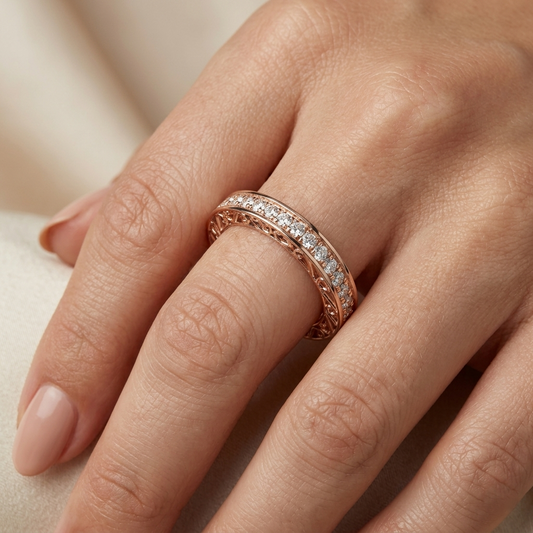
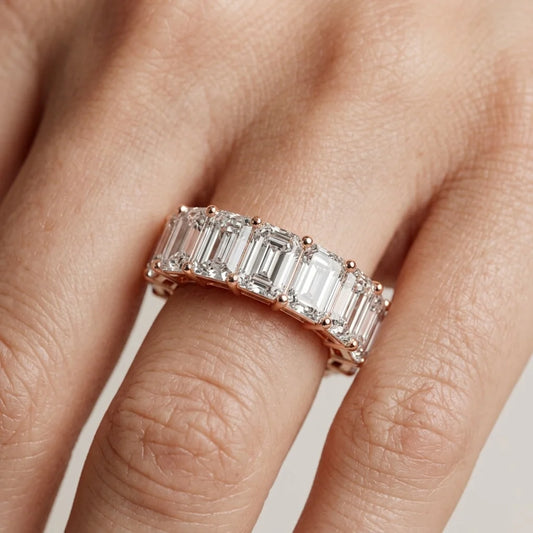
Yes, in all of them. Round brilliants are the most popular, but oval, cushion, pear, emerald cut, princess, marquise, and radiant cut lab grown diamonds are all widely available and often come in at the same price advantage relative to mined stones in those shapes.
Should I tell people my diamond is lab grown?
That's entirely your call and nobody else's business. The stone is a real diamond. But if you're proud of the choice you made, which many buyers are, saying so is also completely accurate.
Bottom Line for Buyers
Lab grown diamonds are real diamonds. They sparkle the same, test the same, and wear the same as any stone pulled from the ground. The only meaningful differences are the price, the origin story, and the current resale market dynamics.
If you're in the market for lab grown diamond jewelry and you want to get the most beauty and quality for your money, the case for going lab grown is genuinely strong right now. You can buy a larger, better-cut stone than your budget would allow with mined diamonds. You can invest more in the setting, the metal quality, or the overall design. You get a certified, graded stone with fully traceable origins.
What you're not getting is a fake. You're not getting a simulation. You're getting a diamond. One that was made differently, yes. But one that will catch light, earn compliments, and last a lifetime exactly the same way as any other.
If that works for you, it should. Its a pretty good deal.