What Are the 4Cs of Diamonds? A Guide for First-Time Diamond Jewelry Buyers
Share

Buying a diamond for the first time can feel like walking into a foreign country where everyone speaks a language you barely recognize. Words like "SI2 clarity" and "excellent cut grade" get thrown around like everyone already knows what they mean. They don't. And nobody tells you that the difference between a $1,200 diamond and a $4,000 diamond can come down to something the naked eye can't even see.
Here's what you actually need to know. The 4Cs — Cut, Color, Clarity, and Carat — are the four qualities that determine the value of any diamond. Whether your shopping for a solitaire engagement ring, a pair of earrings, or exploring lab diamond jewelry as a smarter alternative to mined stones, understanding these four things will save you money and keep you from making a purchase you'll regret.
Let's get into it.
Cut: The One C That Matters Most
Most people assume carat weight is the biggest factor in a diamond's appearance. It's not. Cut is.
The cut refers to how a diamond's facets are shaped, angled, and polished so that light enters, bounces around inside the stone, and exits in a way that produces sparkle. A poorly cut diamond, even a large one, will look dull and lifeless. A well-cut diamond, even a smaller one, will stop people in their tracks.
The GIA (Gemological Institute of America) measure diamond cuts on a scale of Excellent, Very Good, Good, Fair, and Poor. If your budget allows for only one thing, prioritize an Excellent or Very Good cut above everything else. A 1-carat diamond with an Excellent cut will look more impressive than a 1.5-carat diamond with a Good cut. That's not an opinion, it's just how light physics works.
This applies equally to women's jewelry and men's jewelry. Men's diamond pieces, whether it's a wedding band, a solitaire pendant, or a signet-style ring, rely just as heavily on cut quality for visual impact. Don't let anyone talk you into a bigger stone at the cost of the cut grade.
Color: Less Is More Here
Diamond color is graded on a scale from D to Z. D is perfectly colorless, and as you move toward Z, you start to see yellow or brown tones creeping into the stone.
For most buyers, the sweet spot sits somewhere between G and I. Diamonds in this range appear colorless to the naked eye, especially once they're set in a ring or pendant. The difference between a D and an H is nearly impossible to see without a jeweler's loupe, but the price difference can be substantial — sometimes $800 to $1,500 on a single stone.
Here's a practical tip. If you're setting the diamond in yellow gold, you can go even lower on the color scale (J or K) without anyone noticing, because the warm metal reflects into the stone and masks the slight yellow tint. White gold and platinum settings show color more clearly, so staying in the G to H range makes more sense for those.
One thing worth knowing: lab diamond jewelry often performs better on color grades at lower price points. Because lab diamonds are created in controlled conditions, producing colorless stones is more consistent than with mined diamonds. You can regularly find D, E, and F color lab diamonds at prices that would be laughable for equivalent mined stones. A D-color lab diamond might run you around $900 to $1,300 per carat versus $6,000 or more for the mined equivalent. That gap is real.
Clarity: The Most Misunderstood C
Clarity measures the internal characteristics of a diamond, called inclusions, and surface characteristics, called blemishes. The GIA clarity scale runs from FL (Flawless) at the top to I3 (Included) at the bottom, with several grades in between.
Most first-time buyers get caught up chasing a high clarity grade when they really don't need to. Here's the honest truth: anything graded SI1 (Slightly Included 1) or VS2 (Very Slightly Included 2) is going to look perfectly clean to the naked eye. You would need a 10x magnifier to find most of the inclusions in those grades.
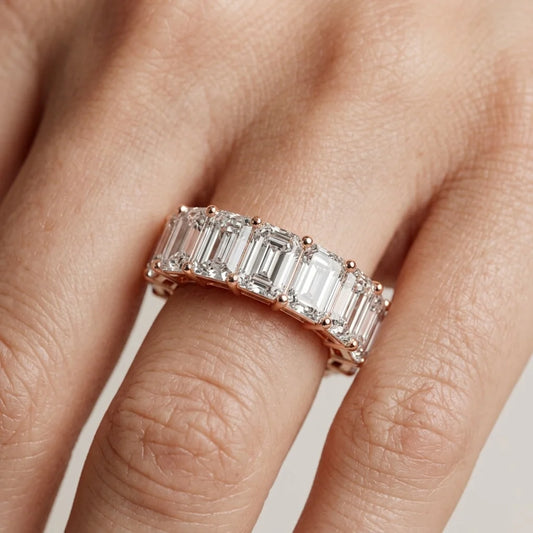
The exception is step-cut diamonds like emerald cuts and Asscher cuts. Because these shapes have large, open facets that act like windows into the stone, inclusions are more visible. If you're buying one of those shapes, you might want to bump up to VS1 or even VVS2.
For round brilliants and most other shapes though, SI1 is the smart buy. You get a stone that looks flawless, and you keep several hundred to several thousand dollars in your pocket.
Where clarity really matters, and where people don't talk about it enough, is in women's jewelry pieces with multiple diamonds. A tennis bracelet or a pavé halo ring puts a lot of small stones side by side. Inconsistent clarity grades across those stones can create a noticeably uneven look. For those pieces, ask for matched clarity grades across the diamonds.
Carat: Weight Is Not the Same as Size
Carat is the measurement of a diamond's weight, not its physical size. One carat equals 200 milligrams. But here's where people get confused: a diamond's appearance of size depends heavily on how the carat weight is distributed across its shape.
Two diamonds can both weigh 1 carat but look very different in physical diameter depending on their cut proportions. A diamond that carries its weight "deep" in the bottom of the stone will look smaller face-up than one with better proportions. This is another reason cut matters so much.
From a pricing standpoint, carat weights just below common benchmarks (0.90 carats instead of 1.00 carat, or 1.85 carats instead of 2.00 carats) can save you 15 to 20 percent without any visible difference in size. The price per carat jumps significantly the moment a diamond crosses certain round-number thresholds. A 0.98 carat diamond doesn't look any different than a 1.00 carat diamond but can be noticeably cheaper.
For men's jewelry, carat selection often comes with different considerations. A large solitaire pendant or a bold ring looks intentional on a man, whereas the same size might look excessive in certain women's settings. Neither is wrong, it just depends on the style you're going for.
How the 4Cs Work Together
No single C tells the whole story. A diamond with a perfect cut, D color, and flawless clarity but only 0.40 carats might cost the same as a 1.00 carat stone with modest grades in everything else. Which one is "better" depends entirely on what you value.
The smart approach is to decide upfront which of the 4Cs you're willing to flex on, and which ones matter most to your specific situation. Most experienced buyers and jewelers will tell you this: never compromise on cut, be strategic about color, buy eye-clean over certified-clean on clarity, and size up slightly below carat benchmarks to save real money.
Lab Diamonds and the 4Cs
One of the biggest shifts in the jewelry market over the last five years is the rise of lab-grown diamonds. These are real diamonds, physically and chemically identical to mined stones. They're graded by the same GIA standards using the exact same 4Cs framework.
The difference is purely origin and price. Lab diamond jewelry gives you access to higher grades in all four categories at a fraction of the cost. For someone who's always wanted a two-carat, VS1, G-color diamond but couldn't justify the price of a mined stone, lab-grown makes that purchase possible without financial stress.
This is especially meaningful for women's jewelry categories like engagement rings and anniversary pieces, where people often feel social pressure to spend more than they comfortably can. And in men's jewelry, where pieces like diamond stud earrings and chains are becoming more mainstream, lab diamonds allow buyers to go bolder without going broke.
A Quick Word on Certification
Whatever diamond you buy, mined or lab-grown, make sure it comes with a grading report from a reputable lab. GIA and IGI are the two most trusted. Some retailers use in-house grading or third-party labs with looser standards, which can mean a stone's actual quality doesn't match what's listed on paper.
A GIA grading report on a lab diamond typically costs between $20 and $60, and any reputable seller will have it. If they don't, walk away.
What First-Time Buyers Get Wrong
The most common mistake is spending the entire budget on carat weight and skimping everywhere else. A 2-carat diamond with a Poor cut grade and heavy inclusions will look worse in person than a 1.2-carat diamond with excellent grades across the board.
The second most common mistake is not comparing lab and mined options side by side. If you're open to lab diamond jewelry, look at both categories with the same budget before making a decision. You might be surprised what a $2,500 budget gets you in lab-grown versus what it gets you in mined. The visual quality of the lab stone will often be significantly higher.
The 4Cs aren't complicated once you see how they connect. Cut drives sparkle. Color drives the "clean" look. Clarity drives confidence in the stone. And carat drives size perception. Get these four things working together, and you'll walk away with a diamond you're genuinely proud of.
Whether you're buying a piece for yourself, for a partner, or searching for something that fits a specific occasion, understanding the 4Cs puts the power back in your hands. And that's the best place for it to be.